


Nuremberg
Nuremberg pairs a genuinely charming medieval old town — the Kaiserburg castle, half-timbered lanes, Germany's most famous Christmas market — with one of the country's most sobering historical sites: the Nazi Party Rally Grounds and Courtroom 600, where the Nuremberg Trials took place. Give it 2 days: one for the old town and its bratwurst-and-lebkuchen food scene, one for the WWII-era history sites, which genuinely deserve a slower, unhurried visit.
Nuremberg holds two very different identities at once, and doesn't try to smooth over the contradiction: a postcard-pretty medieval old town with a castle, a fountain full of wishing-ring tradition, and Germany's most famous Christmas market — sitting a few kilometers from the rally grounds where the Nazi party staged its biggest propaganda spectacles, and the courtroom where its leaders were later tried. Both halves are worth your time, and neither cancels the other out.
How many days do you need in Nuremberg?
Two days works well: one for the old town (Kaiserburg, Hauptmarkt, Albrecht Dürer's House) and the food scene, one for the Documentation Center at the Nazi Party Rally Grounds and the Memorium Nuremberg Trials at Courtroom 600. Both history sites deserve real time, not a rushed hour between other plans.
The old town and Kaiserburg
Nuremberg Castle (Kaiserburg) sits on a sandstone outcrop overlooking the walled old town, a genuinely impressive complex that once hosted Holy Roman Emperors; the courtyard and ramparts are free to walk, with a modest fee for the interior rooms and the Deep Well demonstration. Below it, the old town's narrow, half-timbered lanes survived heavy WWII bombing only in fragments and were carefully rebuilt — it's easy to forget, walking through, how much of what you're seeing is postwar reconstruction rather than untouched medieval fabric.
Hauptmarkt and the Schöner Brunnen
At the Gothic Schöner Brunnen (Beautiful Fountain) on the Hauptmarkt, look for a small golden ring embedded in the wrought-iron fence around its base — local tradition holds that spinning it three times brings good luck. It's easy to miss if you don't know to look, and one of the old town's most genuinely charming small rituals.
The Nazi Party Rally Grounds and Documentation Center
The Reichsparteitagsgelände (Nazi Party Rally Grounds) is the vast, unfinished complex where the Nazi regime staged its massive annual propaganda rallies through the 1930s, including the ones captured in Leni Riefenstahl's 'Triumph of the Will.' The Documentation Center, housed inside the never-finished Congress Hall, holds a permanent exhibition on the rise of the Nazi party and how Nuremberg specifically was used for its propaganda machine — open daily 10am–6pm, adult entry €7.50 (2026 pricing), with the site's newly reopened full exhibition making the whole building publicly accessible again.
Courtroom 600 and the Memorium Nuremberg Trials
A short tram ride from the old town, Courtroom 600 in the city's Palace of Justice is where the International Military Tribunal tried senior Nazi leadership in 1945–46 — the trials that established much of modern international law around war crimes and crimes against humanity. The Memorium Nuremberg Trials museum upstairs covers the trials in real depth (budget 2–3 hours), and the courtroom itself, still occasionally used for actual trials, is viewable when not in session. Adult entry is about €7.50, including a genuinely well-regarded audio guide; closed Tuesdays.
Courtroom 600 can close to visitors without much notice if it's needed for an actual legal proceeding — it remained a working courtroom until as recently as 2020 and is still occasionally used for events. Check the museum's current hours before making a special trip if seeing the courtroom itself, not just the exhibition, is the point of your visit.
What to eat
- Nürnberger Bratwurst — small, finger-sized grilled sausages, traditionally served '3 im Weckla' (three in a bread roll) as a quick street snack, or a full plate of a dozen with sauerkraut for a sit-down meal.
- Lebkuchen — Nuremberg's famous spiced gingerbread, sold year-round but especially central to the Christmas market; look for 'Elisenlebkuchen,' the protected, nut-heavy, higher-quality version.
- Nürnberger Rostbratwurst mit Kraut — the more filling sit-down version of the sausage plate, widely available in old-town restaurants.
The Christkindlesmarkt
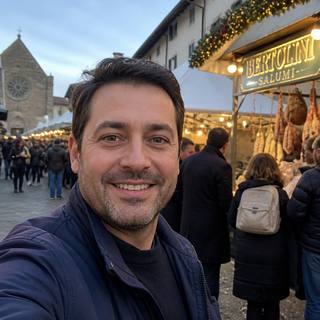
Nuremberg's Christmas market — one of Germany's oldest and most famous, dating back centuries — runs November 27 through December 24, 2026, daily 10am–10pm (December 24 closes early, 10am–2pm), centered on the Hauptmarkt. Entry is free; a ceremonial opening features a costumed local performer as the 'Christkind,' a Nuremberg-specific tradition other German markets have since borrowed. It gets genuinely packed on weekends in December — a weekday evening visit is noticeably calmer.
Getting to Nuremberg
| From | Method | Approx. time |
|---|---|---|
| Munich | Direct ICE train | ~1–1.25 hours |
| Frankfurt | Direct ICE train | ~2 hours |
| Berlin | Direct ICE train | ~3.5 hours |
Mistakes to avoid
- Rushing the Documentation Center or Memorium Nuremberg Trials because they weren't the reason you came — both sites are genuinely well-curated and deserve at least 1.5–2 hours each, not a quick walkthrough.
- Visiting the Christkindlesmarkt only on a weekend in December — it's beautiful, but also extremely crowded; a weekday evening gets you the same lights and Glühwein with far more room to move.
- Skipping the golden ring on the Schöner Brunnen fence because it's easy to miss — it's a small, free, genuinely fun local tradition worth the two minutes it takes to find.
Where to stay in Nuremberg — hotels
Check live availability and prices for hotels, resorts, and guesthouses in Nuremberg on Booking.com:
Search hotels in Nuremberg on Booking.com ←We may earn a small commission, at no extra cost to you.